

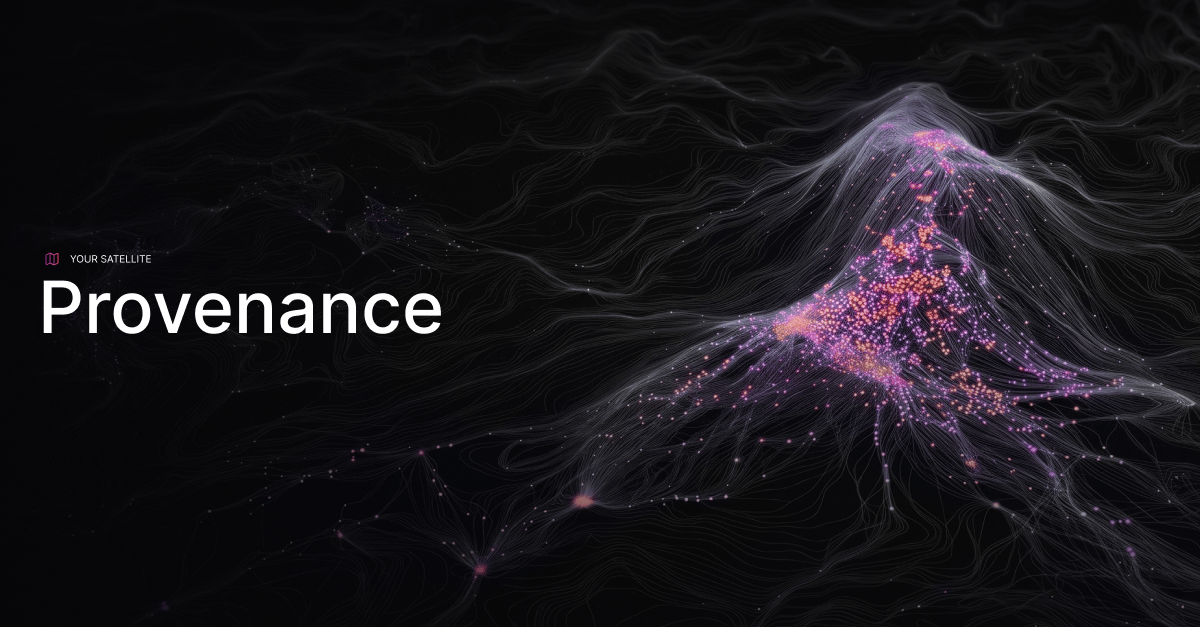
Provenance. The field, at population scale.
What Provenance shows
- Population Signature map: spectral projection of all active participants. Clustering and drift visible without exposing individual identities.
- Protocol activation heatmap: which Protocols are firing, on which surfaces, at what fidelity.
- Cohort comparison: compare defined cohorts (new vs. returning, human vs. agent, region A vs. region B) on any Protocol axis.
- Drift alerts: thresholds fire when a cluster centroid moves beyond the baseline.
- Gravity: what-if scenario planning on top of the live population. Perturb a Protocol threshold, a cohort mix, or a Blueprint version and see how the population geometry moves before you ship the change.
Gravity
Gravity is the counterfactual layer inside Provenance. It runs projections on the current population Signature (no new Dives required) and shows how the map would deform under a specified change. Typical uses:- Rehearse a Blueprint upgrade before rollout.
- Model the impact of a policy change on a specific cohort.
- Stress-test a threshold against historical drift.
Gravity. The field under a different framing.
Privacy model
Provenance operates on aggregate Signature data. Individual actant IDs are never displayed in the population view. Per-actant access is a separate grant and produces an audit log entry.Attribution-resistant aggregation
Population insights flow upward through Protocols that structurally cannot identify individuals. By construction, not by policy.Setup
- Publish a Blueprint via Provenance (Deploy > Provenance in Atlas)
- Attach it to a live Stage or API integration
- Define a Signature baseline (first N interactions, or a pre-loaded reference)
- Set drift alert thresholds per Protocol
- Provenance updates continuously as interactions arrive